
830 views||Release time: Nov 28, 2025
For researchers, a "Scopus Indexed" publication is often the golden ticket. It fulfills graduation requirements, boosts university rankings, and ensures your work is visible to the global scientific community.
However, the high demand for Scopus indexing has created a booming industry of predatory conferences. These scam events promise the world—fast review, guaranteed publishing, and low fees—but deliver nothing. Submitting to them can result in lost money, wasted research, and a damaged reputation.
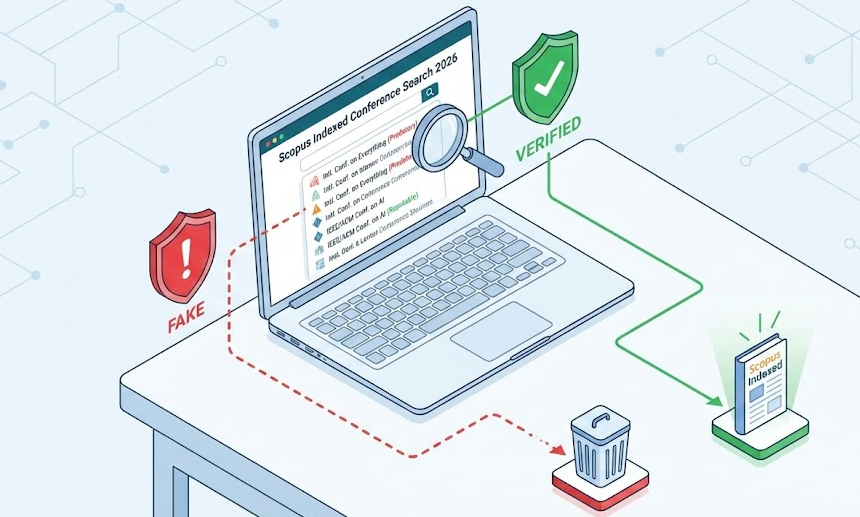
So, how do you distinguish a legitimate academic venue from a sophisticated trap? Here is your 5-step guide to finding reputable Scopus conferences and verifying their claims.
Never trust the conference website alone. Scammers will put the Scopus logo on their site, even if they have no relationship with Elsevier.
You must verify the claim on the official Scopus platform:
Visit
Search for the Publication: Predatory conferences often claim their proceedings will be published in a specific journal (e.g., "Journal of Physics: Conference Series"). Search for that journal name in the Scopus Source List.
Check "Scopus Content Coverage": Click on the journal name. Look at the "Scopus Content Coverage" tab. If the coverage ends in 2022 or 2023 (and it is now 2026), the journal may have been discontinued or is no longer indexing content. This is a massive red flag.
Legitimate conferences cannot guarantee indexing.
The Scam: "100% Scopus Indexed Guaranteed! Publication in 2 weeks!"
The Reality: Scopus is an independent database with its own quality control.
Reputable conferences usually have a track record. They are rarely "1st Annual" events with no history.
Search for Previous Editions: If the conference claims to be the "12th International Conference on AI," search for the "11th" and "10th" editions.
Did they actually happen? Look for photos of the event, a program schedule with real speakers, and most importantly—are the proceedings from those previous years currently indexed in Scopus?
If the past 3 years are indexed: It is highly likely the current year will be too.
If there is no history: Proceed with extreme caution.
Predatory conferences are often "Jack-of-all-trades" events designed to catch as many victims as possible.
Broad Scope: A conference covering "Engineering, Management, Education, and Dentistry" is almost certainly fake. Legitimate conferences are specialized.
Ghost Committee: Copy a committee member's name and search for it + "CV". Does the professor list this conference on their own CV? Scammers often steal names of famous researchers to add credibility without their knowledge.
A general Google search for "Scopus conferences 2026" is dangerous because scammers are very good at SEO. They often rank at the top of search results.
Instead, use curated, human-vetted directories:
iConf: A curated database that manually verifies indexing claims.
Professional Societies: Check the event calendars of IEEE, ACM, Springer, or Elsevier. Events sponsored directly by these organizations are safe bets.
University Lists: Many universities maintain internal lists of "recommended conferences" for their faculty.
Protecting your research requires diligence. If a conference feels "too easy" (fast acceptance, broad topics, guaranteed publishing), it is likely a trap. By spending 10 minutes verifying the event using the steps above, you can save yourself months of regret and ensure your work finds the prestigious home it deserves.

