
937 views||Release time: Nov 28, 2025
You have found a conference that looks perfect. The title fits your research, the location is exciting, and the website promises publication in a Scopus-indexed journal.
But a small voice in your head is asking: Is this real?
In 2026, academic scams are more sophisticated than ever. Predatory conferences use professional web designs, stolen logos, and fake peer reviews to trick researchers into paying registration fees. Submitting to one can cost you thousands of dollars and, worse, lock your hard-earned research into a worthless publication.
You don't need to be a detective to spot them. You just need 5 minutes and this checklist.
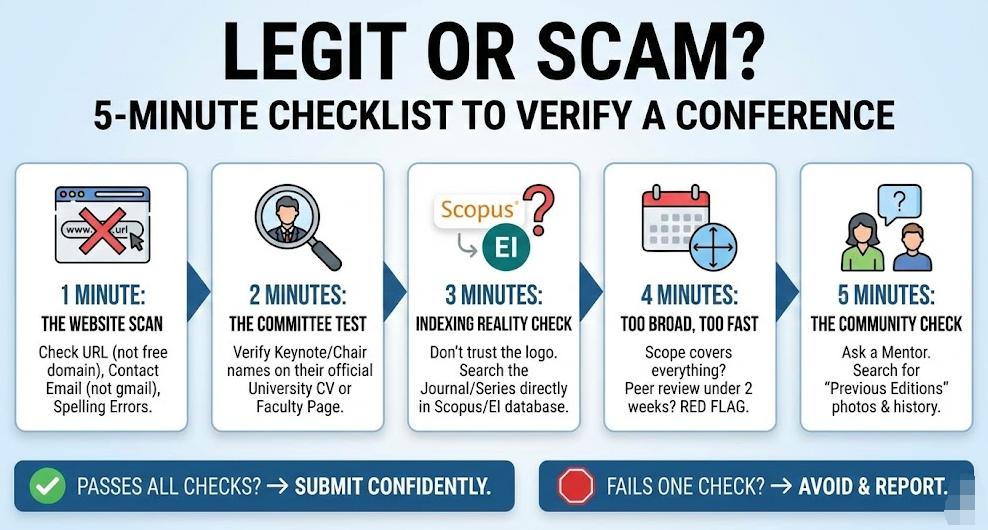
Open the conference website. You are looking for cracks in the façade. Legitimate conferences (especially IEEE, ACM, or Springer events) have high standards.
Check the URL: Is it hosted on a free domain like conference2026.wixsite.com or wordpress.com? Real conferences usually have their own domain or are hosted on a university/society subdomain (e.g., icse-conferences.org or conf.ieee.org).
Check the Contact Email: Does the organizer use a free email address like @gmail.com, @yahoo.com, or @163.com? Legitimate organizers use institutional emails (@university.edu or @organization.org).
Check the Spelling: Are there typos in the banner or the "Welcome" message? Major international events do not have broken English on their homepage.
Predatory conferences often list famous professors as "Keynote Speakers" or "Committee Chairs" without their permission.
Pick one name: Copy the name of the "Conference Chair" or a "Keynote Speaker."
The Google Search: Search their name + "lab" or "university." Go to their official university faculty page.
The Cross-Check: Does their CV or "News" section mention this conference? If they are chairing a major international event, it will be on their CV. If it’s not there, it’s a red flag.
Every scam conference puts the Scopus and EI Compendex logos on their footer. Do not trust the image. You must verify the claim.
Check the Series: Does the conference claim proceedings will be published in a specific series (e.g., "Journal of Physics: Conference Series")?
Go to the Source: Visit the Scopus Source List or EI Compendex database. Search for that specific journal or proceedings series. Is it currently indexed? Is it marked as "Discontinued"?
The "Guaranteed" Trap: If the website says "100% Guaranteed Indexing," run away. No legitimate conference can guarantee indexing; they can only guarantee submission for indexing.
Legitimate science requires focus and time. Scams want volume and speed.
Check the Scope: Does the conference cover "Engineering, Medicine, Education, and Management"? No legitimate conference covers everything. Real events are specialized (e.g., "Deep Learning in Medical Imaging").
Check the Dates: Look at the submission deadline vs. the conference date. Is the deadline just 2 weeks before the conference? Is the "Peer Review" promised to be done in 3 days? Real peer review takes 4–8 weeks minimum.
If you are still unsure, ask the community.
Think. Check. Submit: Use this trusted framework.
Ask a Mentor: Send the link to your supervisor or a senior colleague. They often know the reputation of the organizers instantly.
Check the "Previous Editions": A legitimate conference usually has a history (e.g., "The 12th Annual Conference..."). Search for the "11th" or "10th" edition. Did they actually happen? Are there photos of real people attending, or just stock photos of empty halls?
If a conference fails even one of these checks, do not submit. The academic world is full of high-quality, reputable venues. Do not let a predatory organizer profit from your hard work. When in doubt, stick to verified directories like iConf or official society lists (IEEE/ACM) to ensure your research finds a safe home.

