
1059 views||Release time: Nov 28, 2025
You open your inbox and find an email: "Greetings Eminent Scholar. We were impressed by your recent paper and invite you to be a Keynote Speaker at the International Conference on Advanced Science."
It feels flattering. It sounds legitimate. But it is likely a scam.
Predatory conferences are for-profit events that masquerade as legitimate academic meetings.
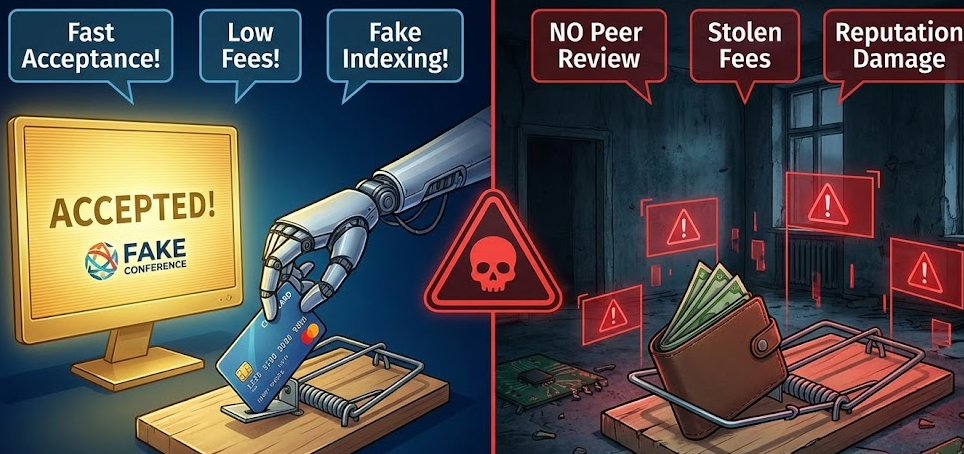
Submitting to one isn't just a waste of money; it can damage your academic reputation.
Here are the 7 critical red flags to help you distinguish a prestigious event from a predatory trap.
Legitimate conferences are specialized. You go to CVPR for Computer Vision or ICSE for Software Engineering.
Predatory conferences try to cast the widest net possible to catch the most victims.
The Red Flag: The conference title combines unrelated fields, such as "The International Conference on Mechanical Engineering, Dentistry, and Philosophy."
The Reality: If the topics listed in the Call for Papers cover "all fields of science," it is a scam.
Peer review is a slow, rigorous process. In respectable IEEE or ACM conferences, review takes 2–5 months.
Predatory conferences want your money now.
The Red Flag: You receive an "Acceptance Notification" within 24 to 72 hours of submitting your abstract.
The Reality: No human being read your paper. An algorithm simply accepted it to prompt you for the payment.
A real conference lists its Technical Program Committee (TPC) with pride, featuring recognized experts from top universities.
The Red Flag: The committee members are not listed, or the names seem made up.
The 2026 Update: Scammers now steal the names of real professors without their permission.
The Test: Google the name of the "Conference Chair." Do they list this conference on their own university CV? If not, they likely don't know they are "chairing" it.
Legitimate top-tier conferences rarely send cold emails begging for papers. They rely on their reputation.
The Red Flag: The email uses odd phrasing like "Greetings Distinguished One" or "We have read your valuable output." It is often sent from a free domain (e.g., @gmail.com or @hotmail.com) rather than a university (.edu) or organization (.org) domain.
Look at the website's homepage. What is the main focus?
The Red Flag: The website is 80% images of the tourist destination (Paris, Bali, Dubai) and 20% about the research. They emphasize "Holiday Packages" or "Visa Support" more than the keynote speakers.
The Reality: It is a travel agency disguised as a conference.
Real conferences have transparent fee structures (Member, Non-Member, Student).
The Red Flag: The fees are hidden until after you submit. Or, they mandate a "publication fee" in addition to the "registration fee."
The Warning: Be wary if they ask for payment via Western Union or to a personal bank account rather than an organizational account.
This is the most dangerous trap for PhD students. The website claims the proceedings will be indexed by Scopus or EI Compendex.
The Red Flag: They use "Look-alike" metrics. Instead of "Thomson Reuters Impact Factor," they list "Universal Impact Factor" or "Index Copernicus."
The Fix: Never trust the conference website alone. Go to the Scopus or EI Compendex source lists and search for the conference name yourself.
Before you upload your PDF:
Check the Sponsor: Is it sponsored by a known entity (IEEE, ACM, Springer, Elsevier)?
Ask a Mentor: "Have you heard of this conference?"
Use a Verified List: Stick to directories like iConf or the CORE Rankings which vet conferences before listing them.
Conclusion If a conference feels too easy to get into, or too good to be true, it is. Protect your research. Stick to established, indexed events found in reputable databases.

