
837 views||Release time: Nov 27, 2025
For every researcher, the "Call for Papers" always ends with a promise: "Proceedings will be submitted for indexing in..."
Usually, you see two acronyms: EI (Compendex) and Scopus.
While both are owned by Elsevier and both are markers of quality, they are not identical.
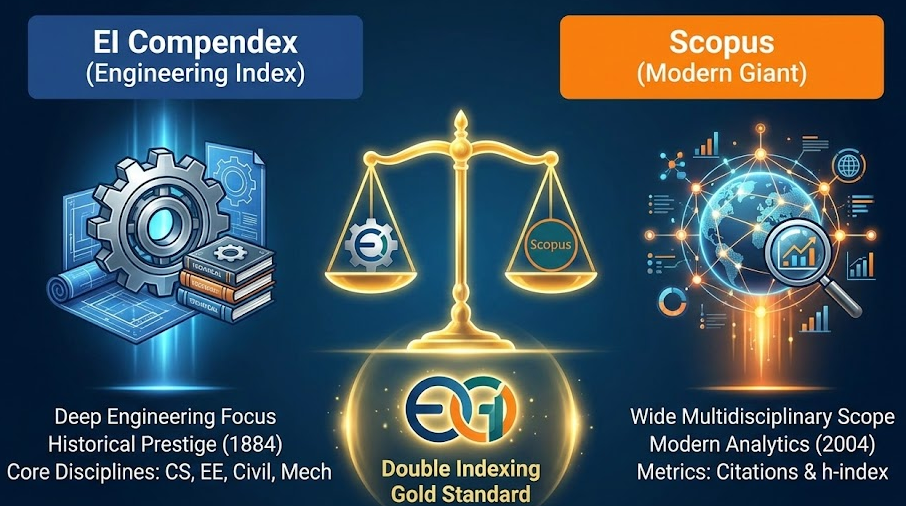
So, in the battle of EI vs. Scopus, which one wins? The answer depends entirely on your field of study.
EI stands for Engineering Index.
The Scope: It is Deep, Not Wide. It focuses exclusively on engineering and applied physical sciences (CS, EE, Civil, Mechanical, Chemical).
The Reputation: For traditional engineering disciplines, EI is the historical benchmark. If you are a Civil or Mechanical Engineer, an EI-indexed paper is often the primary requirement for graduation.
The Rigor: EI is historically perceived as being slightly stricter regarding the engineering relevance of the content.
Scopus is a much younger database (launched in 2004), but it has grown to become the largest abstract and citation database in the world.
The Scope: It is Wide, Not Deep. It covers everything: Science, Technology, Medicine, Social Sciences, and Arts & Humanities.
The Reputation: Scopus is the engine behind modern university rankings (like QS and Times Higher Education).
The Advantage: Because it is larger, Scopus papers often get more visibility outside of strict engineering circles.
| Feature | EI Compendex | Scopus |
| Primary Focus | Engineering & Applied Science | Multidisciplinary (All Sciences) |
| Depth of Coverage | High (Deep Engineering Focus) | High (Broad Coverage) |
| History | 1884 (Historical Prestige) | 2004 (Modern Analytics) |
| Key Metric | Publication Count | Citations & h-index |
| Best For... | Core Engineers (Civil, Mech, Elec) | Interdisciplinary Researchers & Bio/Med |
There is no single "better" index. The value depends on your specific situation.
Winner: EI Compendex (usually)
In many Asian and European universities, Engineering departments specifically mandate "EI retrieval" for PhD graduation. If you submit to a conference that is only Scopus indexed, it might not satisfy your departmental rules.
Winner: Scopus
EI Compendex likely won't even cover your field. Scopus is the standard here. Its broader reach ensures your work is connected to medical and social science literature.
Winner: Scopus
Scopus has the best tools for tracking citations. If your goal is to boost your h-index and track who is citing you, Scopus visibility is essential.
Here is the secret: You shouldn't have to choose.
The highest-quality conferences in the world—such as those sponsored by IEEE or ACM—are almost always indexed by BOTH EI Compendex and Scopus.
If a conference claims to be indexed by only one, ask yourself why.
Is it an engineering conference that wasn't technical enough for EI?
Is it a general conference that wasn't rigorous enough for Scopus?
The Verdict:
For maximum career safety and impact, always target conferences that guarantee Double Indexing (EI + Scopus). This ensures you satisfy the strict graduation requirements of engineering departments (EI) while building your citation metrics on the global stage (Scopus).

