
338 views||Release time: Nov 27, 2025
For PhD students and early-career researchers, receiving an acceptance letter from a conference is a moment of pure joy—immediately followed by the anxiety of the presentation itself.
Standing in front of a room of experts, professors, and peers to defend your work is a rite of passage in academia. Whether you are presenting at a massive international IEEE symposium or a small departmental workshop, the principles of a great talk remain the same. It is not about proving how smart you are; it is about communicating a clear, compelling story about your research.
This guide provides a complete roadmap to help you transition from writing a paper to delivering a presentation that establishes you as a promising voice in your field.
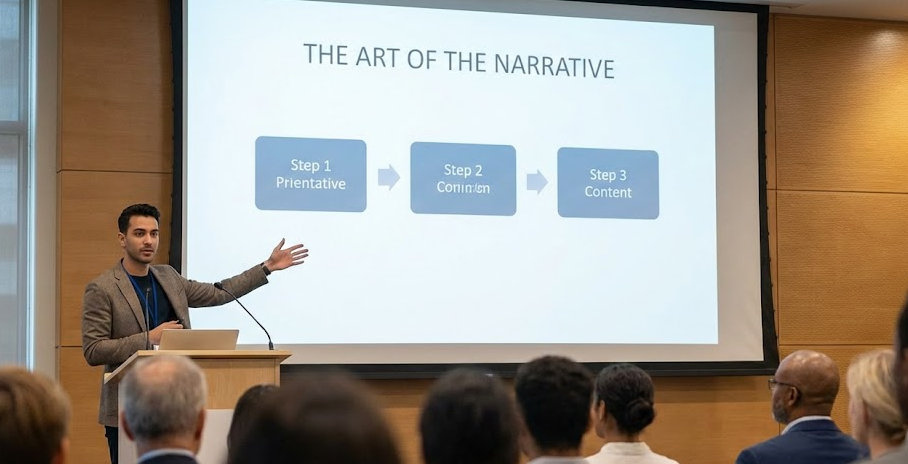
The single biggest mistake beginners make is trying to cram their entire 8-page conference paper into a 15-minute talk. Do not do this.
Your paper is for reading; your presentation is an advertisement for the paper. To keep your audience engaged, you must shift from a dense academic style to a narrative arc.
Focus on this 5-step structure:
The Hook (1-2 mins): Start broad. What is the big-picture problem? Why should the audience care? Avoid heavy jargon in the first minute to ensure everyone is on board.
The Gap (2 mins): What have other researchers done, and why isn't it enough? This sets the stage for your specific contribution.
The Solution (5 mins): This is the core of your talk. Explain your methodology clearly. Use diagrams and flowcharts to explain your system or approach, rather than walls of text.
The Evidence (4 mins): Show your key results. Use clean, readable graphs to prove that your solution works better than the status quo (SOTA).
The Takeaway (1 min): If the audience remembers only one thing from your talk, what should it be? Summarize your main contribution in one sentence.
Your slides are a visual aid, not a teleprompter. If you are turning your back to the audience to read your slides, you are losing their attention.
Follow these design rules for maximum impact:
One Idea Per Slide: Do not clutter your slides. Each slide should convey a single message.
Fonts Matter: Use standard sans-serif fonts (like Arial, Helvetica, or Roboto). Ensure your text is size 24pt or larger so it is readable from the back of the room.
Visuals Over Text: The human brain processes images 60,000 times faster than text. Replace bullet points with block diagrams, flowcharts, and high-resolution graphs whenever possible.
The "6-6 Rule": As a rough guideline, aim for no more than 6 bullet points per slide, and no more than 6 words per bullet point.
You have built a great deck; now you have to deliver it. Nerves are normal, but preparation is the antidote.
Timing is Sacred: If you are allotted 15 minutes, stop at 15 minutes. Going overtime is considered disrespectful to the next speaker and the session chair. Practice until you hit 14 minutes consistently.
Eye Contact: Look at the audience, not the screen. Pick three people in different parts of the room (left, center, right) and rotate your gaze between them.
Voice Control: Nervous speakers tend to speed up. Consciously force yourself to slow down, especially when explaining complex formulas or methodologies. Pausing for effect is powerful.
For many researchers, the Question & Answer session is the scariest part of the experience. Remember: Q&A is a dialogue, not an interrogation.
Strategies for handling questions:
The "I Don't Know" Answer: It is okay not to know everything. If you are stumped, do not fake it. Say: "That is an excellent question. We haven't looked into that specific variable yet, but it would be a great direction for future work." This demonstrates scientific rigor and humility.
Repeat the Question: Always paraphrase the question before answering. This ensures the whole room heard it and buys you a few seconds to think.
Don't Be Defensive: If a senior researcher critiques your work, do not fight back emotionally. Simply reply, "Thank you for that feedback; I will consider that for the next iteration of this project."
Before you step onto the stage, run through this final checklist to ensure you are ready:
[ ] Text Reduction: Did I cut the text on my slides by at least 50%?
[ ] Readability: Is my font size (24pt+) readable from 10 meters away?
[ ] Timing: Did I practice out loud with a timer and finish early?
[ ] Clarity: Do I have a clear "Takeaway" slide at the end?
Your first academic presentation does not need to be perfect; it just needs to be clear. The audience wants you to succeed—they are there to learn from you, not to judge you. By preparing a structured narrative, designing clean visuals, and respecting the time limit, you will not only survive your first talk but impress your peers.
Good luck!

