
162 views||Release time: Jul 03, 2026
Biomedical signal processing stands at the intersection of electrical engineering, physiology, and data science. For researchers aiming to publish high-impact work, IEEE remains the premier publisher for this interdisciplinary field. Navigating the diverse array of IEEE venues requires a clear strategy, as each journal and conference maintains distinct editorial priorities and technical focuses.
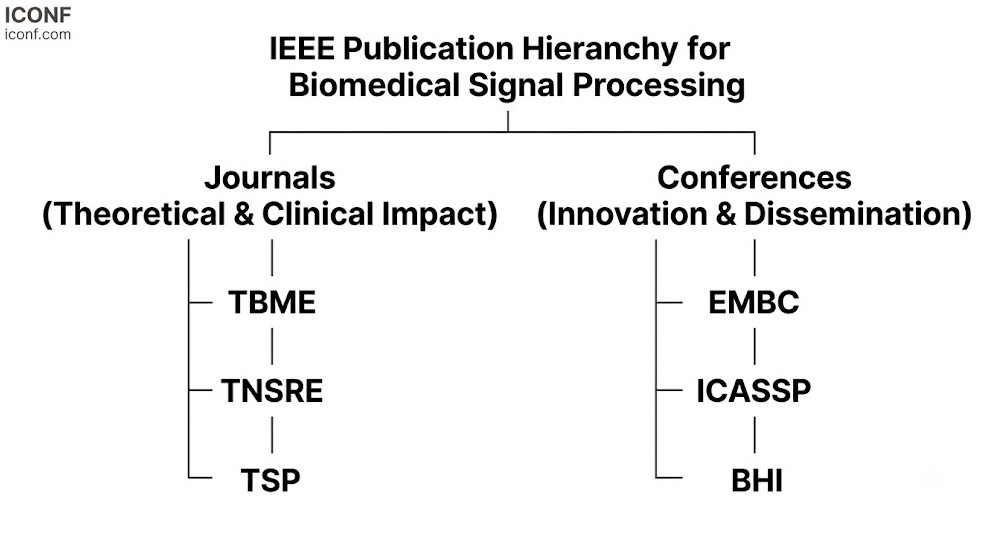
In 2026, the landscape for IEEE biomedical signal processing publications remains centered on a few high-impact Transactions and flagship conferences that consistently set the benchmark for quality and innovation.
When research is mature, robust, and offers significant theoretical or applied contributions, IEEE Transactions journals are the gold standard.
IEEE Transactions on Biomedical Engineering (TBME): This is the flagship journal for the field. TBME publishes original research involving the application of engineering principles and signal processing techniques to biomedical problems. It is highly competitive and favors work that demonstrates physiological significance alongside rigorous technical methodology.
IEEE Transactions on Neural Systems and Rehabilitation Engineering (TNSRE): If your signal processing research is centered on brain-computer interfaces (BCI), neural prosthetics, or rehabilitation robotics, this is the premier venue. It focuses on the translation of signal processing theory into systems that interact directly with the nervous system.
IEEE Transactions on Signal Processing (TSP): While not exclusively biomedical, TSP is the theoretical heart of the field. Researchers developing fundamental signal processing algorithms—such as blind source separation, denoising, or adaptive filtering—with clear applications in medical imaging or biosignals often target this journal to emphasize their methodological innovation.
IEEE Transactions on Instrumentation and Measurement (TIM): This venue is increasingly prominent for research focusing on the hardware and sensor-side of biomedical data acquisition. If your paper deals with novel sensor design or robust signal processing architectures for wearable devices, TIM is a strong candidate.
Conferences in this field are crucial for disseminating preliminary findings, novel dataset methodologies, and real-time analytical tools.
IEEE EMBC (Annual International Conference of the IEEE Engineering in Medicine and Biology Society): EMBC is the largest and most comprehensive international meeting of biomedical engineers. It covers all areas of biomedical signal processing, from neural engineering to medical informatics. It is an essential venue for researchers needing immediate feedback from the global community.
IEEE ICASSP (International Conference on Acoustics, Speech and Signal Processing): While broad in scope, ICASSP consistently hosts dedicated sessions for biomedical signal processing. Submitting here is ideal if your work focuses on speech signals (e.g., laryngology) or general acoustic signal processing applied to healthcare.
IEEE BHI (International Conference on Biomedical and Health Informatics): This conference focuses heavily on the digital, data-driven side of biomedical signal processing. It is the preferred venue for work involving big data, health monitoring systems, and the integration of signal processing with clinical workflows.
Selecting the right venue in 2026 requires assessing the primary contribution of your manuscript:
Theoretical Breakthroughs: If your paper introduces a novel algorithm that challenges current mathematical limits, target IEEE Transactions on Signal Processing (TSP) or the "Methods" sections of TBME.
Clinical Utility and Efficacy: If your signal processing framework provides a clear diagnostic advantage or therapeutic improvement, TBME or EMBC are the appropriate venues to emphasize clinical impact.
Hardware and System Integration: Research that integrates signal processing into novel medical hardware, wearables, or portable diagnostics is well-aligned with IEEE Transactions on Instrumentation and Measurement (TIM).
By aligning your manuscript with the editorial scope of these specific venues, you ensure that your research reaches the intended audience, undergoes relevant peer review, and gains the necessary credibility for professional progression.

