
458 views||Release time: Mar 17, 2026
When you log into an academic conference portal and see a "Revise and Resubmit" or "Major Revision" status, it is both a relief and a challenge. Your paper has avoided a desk rejection, but you still face the critical final hurdle before acceptance.
The core factor determining your final publication is not just how much data you changed in the manuscript, but the quality of the Response to Reviewers (often called a Rebuttal Letter) that you submit alongside it.
Reviewers are top-tier academics volunteering their limited time. A disorganized, defensive letter will instantly frustrate them, while a highly structured, polite, and professional letter will earn their respect. Here are the four core strategies for writing a flawless response letter.
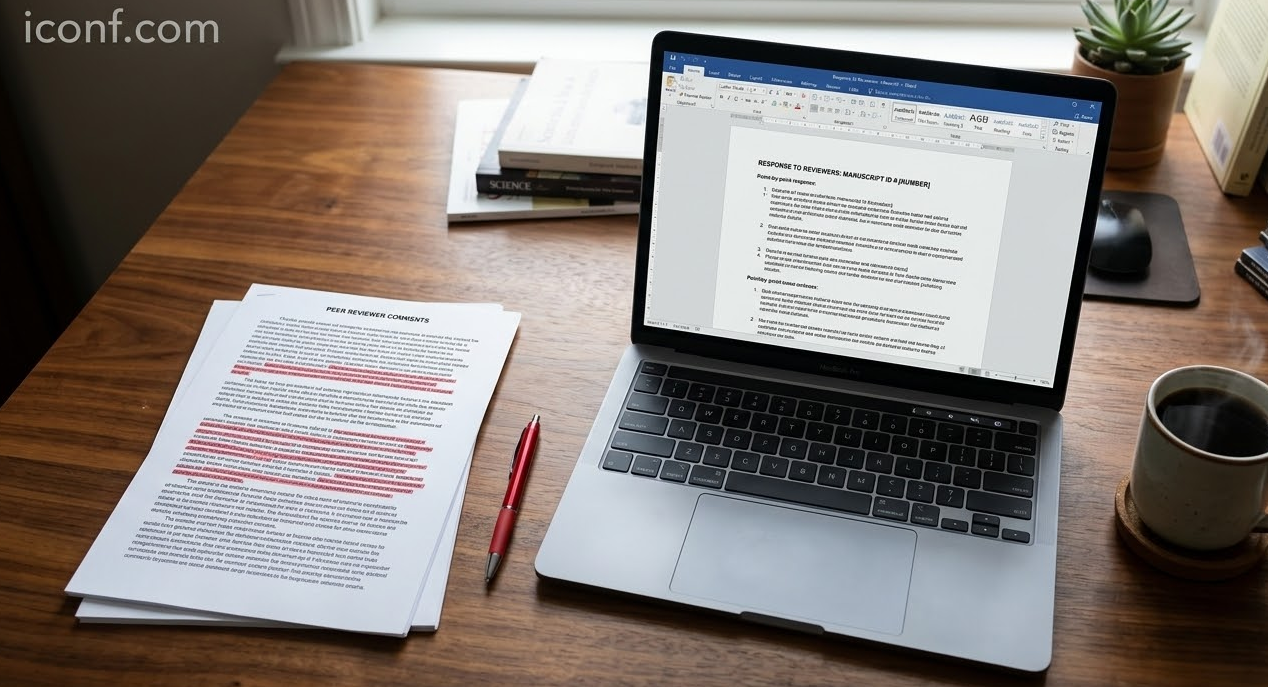
It is entirely natural to feel defensive or frustrated when your hard work is criticized. However, you must strip all personal emotion from your response letter.
Open with Gratitude: Begin your letter by sincerely thanking the Program Committee and the reviewers for their time and constructive feedback.
Standard Phrasing: "We would like to express our sincere gratitude to the reviewers for their insightful comments and constructive suggestions, which have significantly improved the quality of our manuscript."
Never Blame the Reviewer: Even if a reviewer's comment seems uninformed or completely misses the point of your research, absolutely never use a sarcastic or accusatory tone. Remain objective, calm, and data-driven.
Reviewers are exceptionally busy. They do not have the time or patience to hunt through your revised PDF to figure out what you changed. You must spoon-feed the revisions to them.
Copy the Original Comments: Paste every single comment from Reviewer #1 and Reviewer #2 into your letter, no matter how minor. Use bold text or a gray background to visually separate their words from yours.
Provide a Clear "Author Response": Below each comment, state your stance clearly (e.g., whether you completely agree, partially agree, or are providing clarification).
Detail the "Action Taken": Explicitly map out the exact physical changes you made in the revised manuscript. You must cite specific page numbers, sections, and line numbers.
Standard Phrasing: "We completely agree with this suggestion. We have recalculated the error margin and updated Table 2 on Page 4, Paragraph 3."
If a reviewer asks a question because they fundamentally misread a section of your paper, replying with "You didn't read page one carefully" is incredibly rude.
In academic discourse, if a reader misunderstands your point, the standard professional strategy is to take the blame—meaning you admit your original writing was not clear enough.
Polite Clarification Phrasing: "We apologize if our original description of the algorithm was ambiguous. To clarify this point for all future readers, we have heavily rewritten Section 3.2 to explicitly detail the parameter settings." This corrects the reviewer's misunderstanding while allowing them to save face.
You are not obligated to agree with every single critique. If you believe a request is unreasonable (such as running a highly time-consuming, non-core experiment, or using an incompatible statistical model), you can refuse, but you must provide an airtight scientific defense.
Use Cushioning Language: Do not simply write, "We disagree."
Cite Third-Party Literature: Use other established research to back up your decision.
Refusal Phrasing: "While we agree with the reviewer that [Method X] is valuable, our specific dataset contains non-linear noise. As demonstrated by Smith et al. (2025), applying [Method X] in this scenario can introduce artificial biases. Therefore, we have chosen to retain our original methodology, but we have added a new paragraph in the Limitations section to openly discuss this trade-off."
Before exporting your letter as a PDF and uploading it to the conference portal, run through this final checklist:
Did I address every single comment from every single reviewer? (Never skip the hard questions).
Do the page and line numbers in my letter perfectly match the newest version of the PDF I am uploading?
Does the overall tone sound like a rational, mature discussion between two professional scientists?

