
654 views||Release time: Mar 16, 2026
Securing an acceptance letter for an international academic conference is a massive academic achievement. However, the excitement is often immediately followed by a daunting administrative hurdle: figuring out how to pay for the flights, hotels, and registration fees.
Academic travel is expensive, and very few researchers pay out of pocket. The global academic ecosystem is sustained by a complex network of travel grants, society sponsorships, and institutional funding.
If you need to secure financial backing to present your research, here is a strategic guide on where to look for money and how to build a funding application that gets approved.
The biggest mistake early-career researchers make is assuming there is only one pot of money. You should always diversify your funding requests. Begin your search locally and expand outward.
Your Home Department or Lab: This is your primary source of funding. Most academic departments have a dedicated annual budget for graduate student and faculty travel. Ask your department coordinator or Principal Investigator (PI) about internal travel awards.
The University Graduate School: If your specific department is out of funds, look at the broader university level. Many universities have a central "Graduate Student Association" or "Postdoctoral Affairs Office" that offers competitive micro-grants (typically ranging from $500 to $1,500) specifically for conference presentations.
The Conference Organizers: High-quality international conferences want diverse, global representation. Review the conference website for a "Financial Aid," "Student Volunteer," or "Travel Grant" tab. Organizers often waive registration fees or provide hotel stipends for students who agree to work the registration desk for a few hours.
Professional Societies: Organizations like IEEE, ACM, the Royal Society, or the American Chemical Society offer highly lucrative travel grants to their active members. You usually must be a registered member for at least a few months before applying.
When you apply for a travel grant, the funding committee is viewing your application as an investment. You must prove that sending you to this specific event will yield a high return on investment for the institution.
A successful funding request must include three critical components:
Proof of Acceptance: Funding boards rarely distribute money for mere attendance. You must attach the official "Notification of Acceptance" email proving that you are actively presenting a paper or a poster.
The Justification of Impact: Do not just say, "I want to present my research." Explain exactly who will be there. State something like, "This is the premier global venue for [Your Field]. Attending will allow me to present our lab's findings to leading experts, specifically Dr. X and Dr. Y, potentially opening doors for future post-doctoral collaborations that will benefit our department's network."
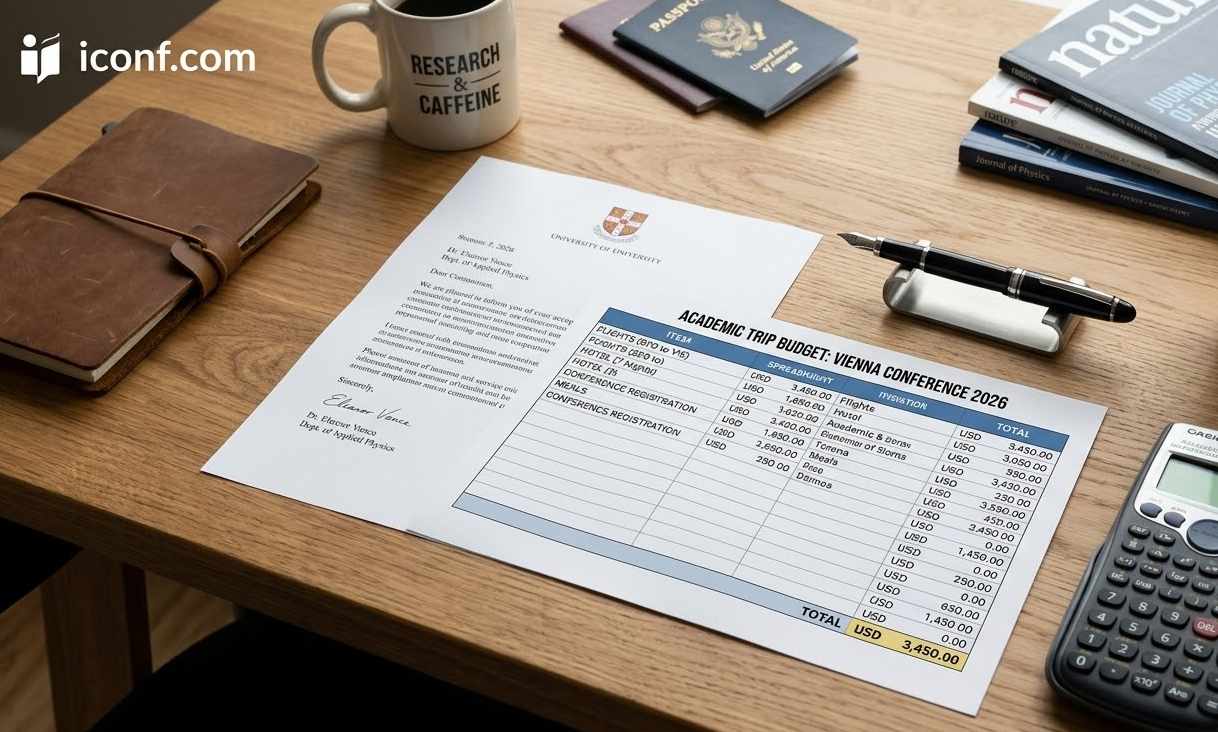
A Meticulous, Itemized Budget: Never ask for a generic lump sum. Provide a hyper-specific spreadsheet detailing the exact cost of the conference registration, the economy-class airfare (with a screenshot of the current flight price), the nightly hotel rate, and the daily per diem for meals.
The timeline for securing funding is often much longer than the timeline for writing the actual paper.
Apply Early: Institutional travel grants are almost always distributed on a rolling, first-come, first-served basis. The moment your paper is accepted, your funding application should be submitted.
Retroactive Funding is Rare: Never assume your university will reimburse you if you pay for the trip yourself and ask for the money afterward. Most finance departments require travel authorizations to be signed and approved weeks before your departure date.
Winning the grant is only half the battle; actually getting the money deposited into your bank account requires flawless administrative compliance.
Always keep the physical and digital receipts for every single transaction. A standard credit card statement is usually not enough. Finance auditors require itemized receipts showing exactly what was purchased, the currency used, and a zero-balance confirmation. If you lose your hotel invoice or your flight boarding passes, the university is legally allowed to withhold your reimbursement.

