
878 views||Release time: Mar 12, 2026
In the engineering and computer science fields, having a paper accepted into an EI-indexed conference is a major academic milestone. However, when researchers begin preparing their CVs or university graduation portfolios, they often frantically search for the conference's "Impact Factor."
The short and definitive answer is: No, EI-indexed conference proceedings do not have an Impact Factor. This is one of the most common misconceptions in academic publishing. The confusion stems from mixing up two entirely different corporate databases and the specific types of publications they measure. Here is the exact breakdown of why EI conferences lack an Impact Factor and what metrics you should be looking for instead.
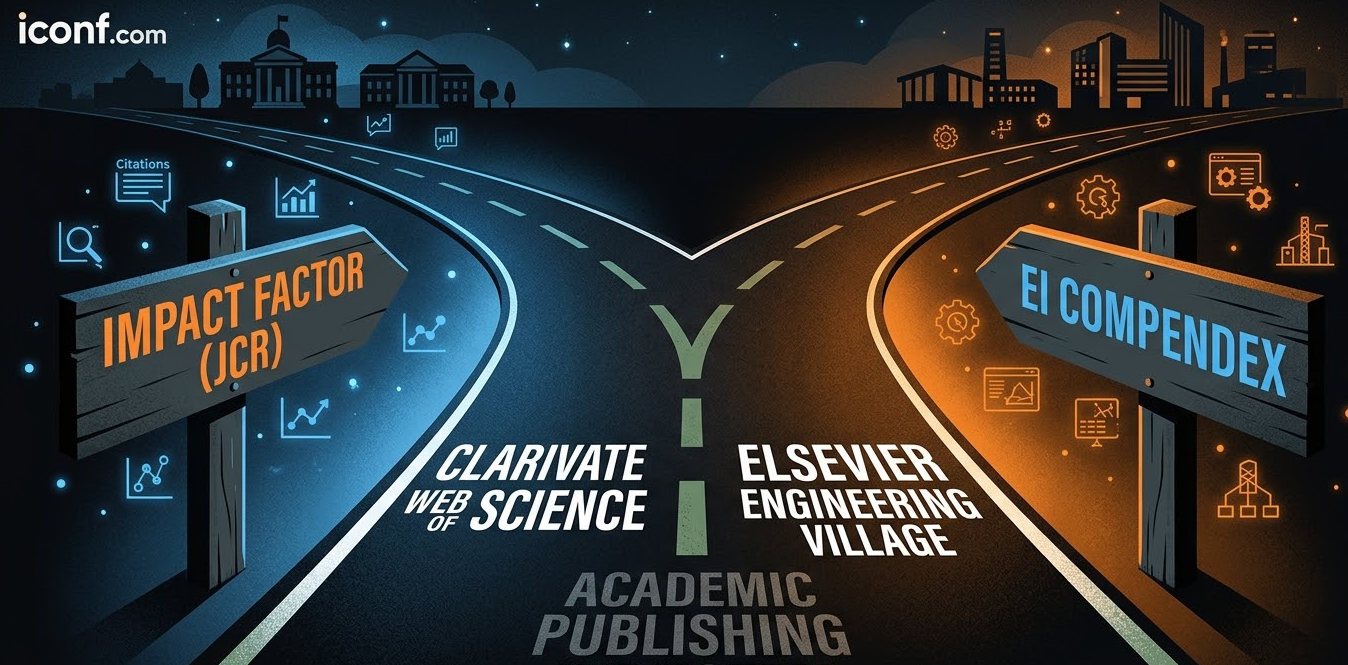
The term Impact Factor (IF)—or more accurately, the Journal Impact Factor (JIF)—is a proprietary metric owned and calculated by Clarivate Analytics (the parent company of the Web of Science and the Journal Citation Reports).
EI Compendex, on the other hand, is a database owned and operated by a completely different corporate entity: Elsevier (hosted on the Engineering Village platform).
Because these are rival databases managed by competing companies, Elsevier’s EI Compendex does not use Clarivate’s proprietary metrics.
Even if we ignore the corporate rivalry, there is a fundamental structural rule regarding how Clarivate calculates its metrics: The Impact Factor is designed exclusively for academic journals.
An Impact Factor measures the yearly average number of citations that recent articles published in a given journal received.
There is exactly one scenario where a paper presented at an EI conference might be associated with an Impact Factor.
Occasionally, highly prestigious conferences will partner with an SCI-indexed journal. The conference committee will select the top 10% of presented papers and invite the authors to expand their work (usually by adding 30% to 50% new data) for publication in a "Special Issue" of that journal.
If your expanded paper is published in that SCI journal, it inherits the journal's Impact Factor. However, it is the journal that holds the metric, not the conference itself.
If you cannot use an Impact Factor to prove the prestige of your EI conference paper to your tenure committee or funding board, you must rely on the correct industry-standard metrics:
Scopus CiteScore: Because Scopus is also owned by Elsevier, EI-indexed conferences are almost always dual-indexed in Scopus. Scopus assigns a "CiteScore" to serial conference proceedings.
Google Scholar h5-index: Google Scholar Metrics provides an h5-index for major conferences.
Acceptance Rate: In computer science and engineering, a low acceptance rate is the ultimate badge of honor. A conference that only accepts 15% of submitted papers is universally recognized as top-tier, regardless of any other citation metric.
Never list an "Impact Factor" next to a conference paper on your CV; doing so immediately signals to senior academics that you do not understand how publishing metrics work. Instead, focus on the fact that the paper successfully passed the rigorous EI Compendex indexing process, and use CiteScore or acceptance rates to quantify the venue's prestige.

