
1228 views||Release time: Mar 12, 2026
For researchers, choosing the right journal is about more than just finding a good editorial fit; it is about maximizing career impact. Whether you are structuring the indexing criteria for an academic publishing platform, or preparing to discuss global publication strategies with international scholars during a late-March business trip to Yokohama, understanding how journals are evaluated across different regions is essential.
Two primary systems dominate the academic landscape: the JCR Quartile system and the CAS Ranking system. While both evaluate journal quality based on citation data, their methodologies and target audiences are vastly different.
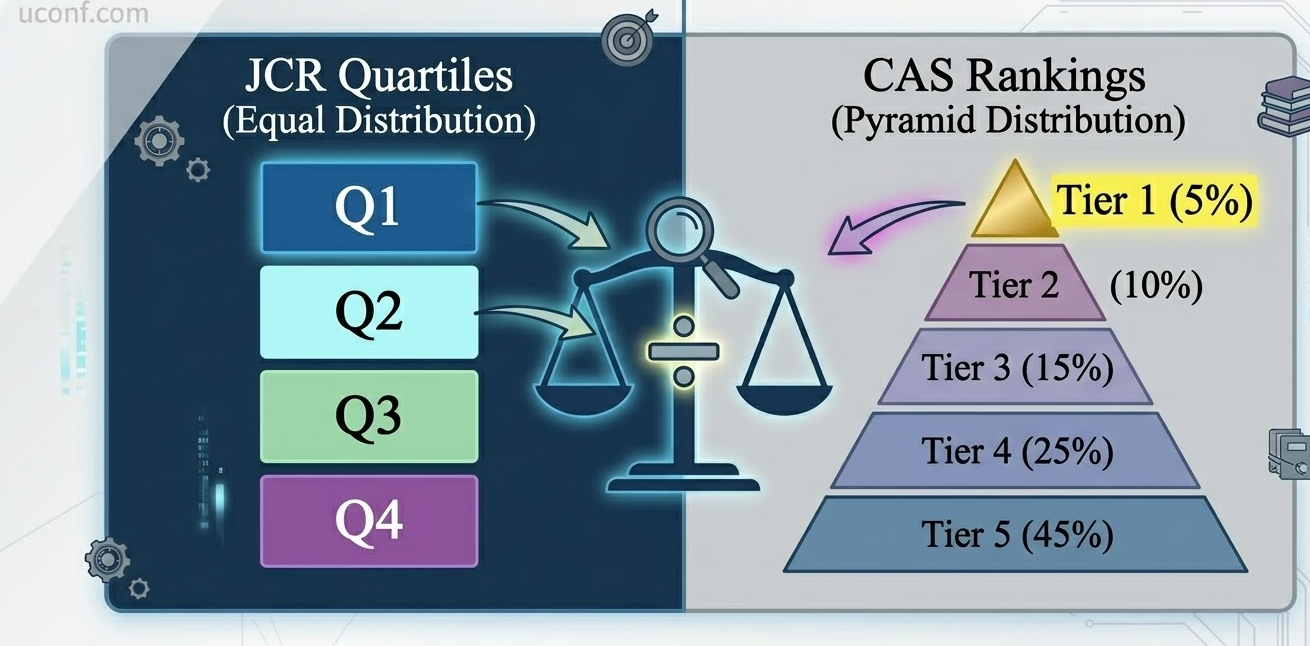
Here is the definitive guide to understanding the differences between JCR and CAS, and which metric ultimately matters more for a researcher's career.
The Journal Citation Reports (JCR) system is maintained by Clarivate Analytics (the company behind the Web of Science).
JCR groups journals into specific subject categories (e.g., Artificial Intelligence, Physical Chemistry) and ranks them purely based on their Journal Impact Factor (JIF).
Q1 (Top 25%): The most prestigious journals in that specific category.
Q2 (26% - 50%): Highly respected, mainstream journals.
Q3 (51% - 75%): Average-performing journals.
Q4 (Bottom 25%): Lower-tier or newly emerging journals.
The CAS Ranking (中科院分区) is maintained by the National Science Library of the Chinese Academy of Sciences. While it utilizes the raw citation data provided by Clarivate, it applies a completely different, highly stringent algorithm to sort the journals.
Instead of equal quarters, the CAS system uses a highly exclusive pyramid structure divided into four Tiers (often called Zones or 区):
Tier 1 (Top 5%): The absolute elite journals.
Tier 2 (6% - 20%): Excellent, high-impact journals.
Tier 3 (21% - 50%): Solid, average journals.
Tier 4 (Bottom 50%): The lower half of all indexed journals.
Furthermore, CAS categorizes journals into 18 broad "Major Categories" (e.g., Engineering, Medicine) alongside more specific subcategories, whereas JCR relies on over 250 highly narrow categories.
The structural difference between a quarter and a pyramid creates massive discrepancies in how a single journal is perceived.
The "Q1 vs Tier 2" Dilemma: Because JCR Q1 includes the top 25%, and CAS Tier 1 only includes the top 5%, a vast number of globally recognized Q1 journals are downgraded to Tier 2 under the CAS system.
The "Warning Journal" Filter: The CAS system is highly proactive against predatory publishing. If a journal exhibits suspicious self-citation patterns, suddenly inflates its publication volume, or has a high retraction rate, CAS will place it on an official "Early Warning List." A journal can be a JCR Q1, but if it is on the CAS Warning List, its academic value drops to zero in certain regions.
Metric Evolution: While JCR has historically relied heavily on the raw Impact Factor, the CAS algorithm increasingly weighs the Journal Citation Indicator (JCI) and peer-review reputation to prevent publishers from gaming the math.
The answer depends entirely on your geographic location and your institutional affiliations.
When JCR Matters More: If you are a researcher based in North America, Europe, or most parts of Asia outside of China, the JCR Quartile is the ultimate gold standard. Tenure committees, grant funding agencies, and international hiring boards almost exclusively look at whether you are publishing in Q1 or Q2 journals.
When CAS Matters More: If you are a researcher in China, or if you are an international researcher seeking joint funding or employment with a Chinese institution, the CAS Ranking is the absolute law. Chinese universities, hospitals, and government funding bodies use the CAS tiers to dictate graduation requirements, calculate financial publication bonuses, and award tenure. In this ecosystem, an international Q1 journal means nothing if the CAS ranks it as Tier 3.

