
968 views||Release time: Mar 12, 2026
In collaborative research, it is common for a project to be spearheaded by two separate labs or led jointly by a senior Principal Investigator and a postdoctoral researcher. When it is time to publish, deciding who handles the communication and takes public responsibility for the data can be complicated.
The short answer is yes, an academic conference paper can have multiple corresponding authors. However, there is a massive difference between what you print on your final PDF and how the conference's backend software operates.
Here is everything you need to know about navigating the rules of co-corresponding authorship for international academic conferences.
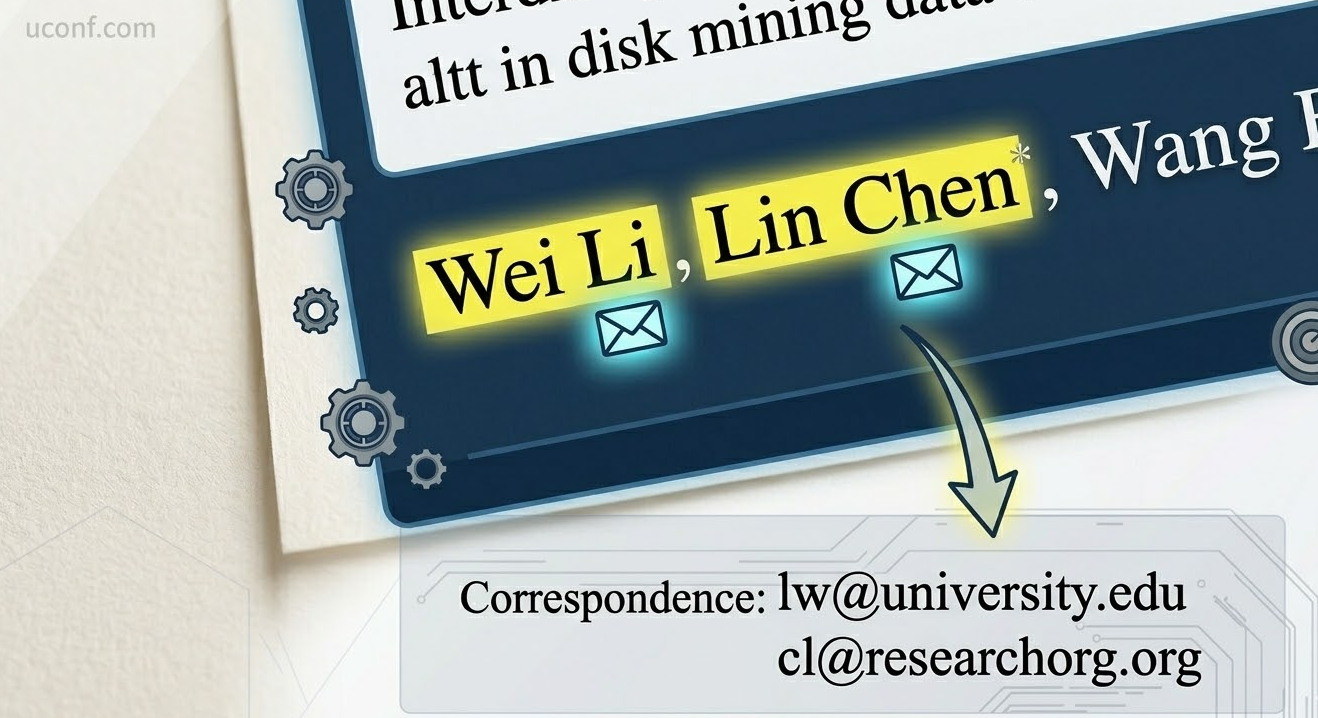
The biggest source of confusion for submitting authors is the conflict between the written manuscript and the online submission system (such as EDAS, EasyChair, or CMT).
The Online Portal (Administrative Limit): Almost all conference submission portals are hardcoded to allow only one primary contact person. The system needs a single email address to send automated peer-review updates, acceptance notifications, and formatting revision requests. If you are the one uploading the paper, you are the administrative corresponding author.
The PDF Manuscript (Academic Record): The PDF is the final legal document of record. On the actual pages of the manuscript, you can designate multiple corresponding authors. Once published in the digital library, readers will see that two or more individuals are officially designated to answer questions about the research.
Because standard publisher templates (like IEEE or Springer) do not have a pre-built "Co-Corresponding" text box, you must format it manually using footnotes.
The Marker: Place an identical symbol—usually an envelope icon or a specific superscript letter/asterisk—immediately following the names of the designated corresponding authors in the title block.
The Footnote: At the bottom of the first page, create a footnote keyed to that symbol.
The Text: Explicitly state the roles and provide the emails. For example: "Corresponding authors: Jane Doe (jane.doe@university.edu) and John Smith (john.smith@institute.org)."
While the general rule allows for multiple corresponding authors, different publishers handle the metadata slightly differently.
IEEE Conferences: IEEE permits multiple corresponding authors on the PDF. However, their electronic copyright transfer system (eCF) will strictly require the single administrative corresponding author to sign the copyright form on behalf of all others.
Springer Proceedings: Springer is highly accommodating of multiple corresponding authors. Their templates actively encourage the use of the envelope icon for multiple people. Ensure that all corresponding authors also have their ORCID identifiers linked in the manuscript.
ACM Conferences: ACM also allows multiple corresponding authors. During the final rights-management phase, the primary administrative contact will receive the forms, but the final published metadata in the ACM Digital Library will display the multiple contact emails provided in your PDF.
Designating more than one corresponding author is not just an ego boost; it serves practical scientific purposes:
Cross-Institutional Collaboration: If a paper is funded equally by two different universities, designating a corresponding author from each institution ensures both labs receive equal administrative credit.
Career Transitions: If the primary researcher (e.g., a PhD student) is graduating and losing access to their university email address, listing the permanent senior lab director as a second corresponding author ensures the public can always reach someone about the data.
Interdisciplinary Projects: If a paper combines deep machine learning with complex biology, readers may need to contact the computer scientist for the code and the biologist for the lab protocols.
While two or three corresponding authors are perfectly acceptable, listing four or five is generally viewed as an abuse of the system by editorial committees. The corresponding author is supposed to be the definitive expert responsible for the paper's integrity. If everyone is responsible, no one is. Keep it limited to the actual project leaders.

