
1006 views||Release time: Feb 27, 2026
The academic publishing landscape in 2026 is highly competitive. Because universities and funding bodies demand constant publication output, a massive shadow industry of predatory conferences has emerged to exploit this pressure.
These fake organizations exist for one reason: to collect your registration fees. They offer zero peer review, fake their indexing claims, and provide no academic value. If you publish your research with a predatory organizer, your paper will not be indexed in Scopus or EI Compendex, and the publication will be functionally useless for your career.
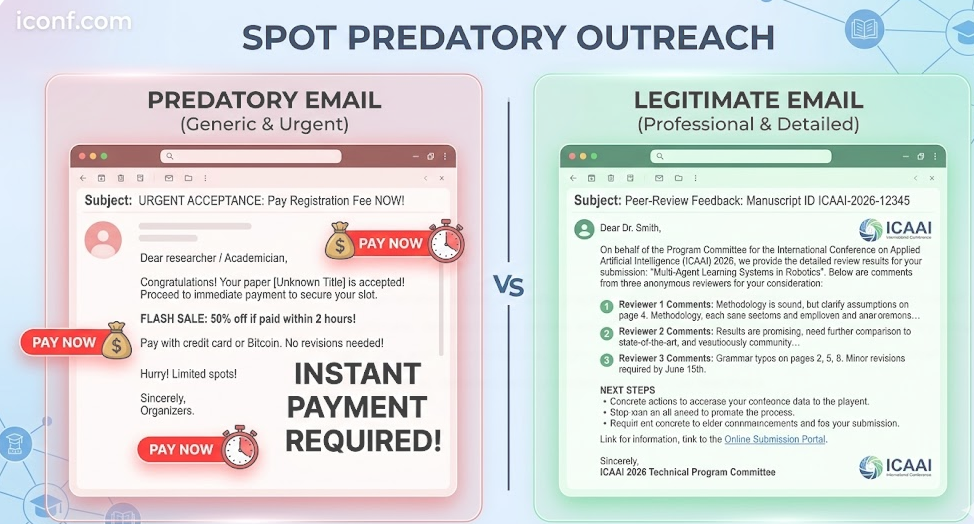
Here are the critical red flags to look for and the exact steps to verify a conference's legitimacy.
Legitimate academic peer review takes time. It requires coordinating multiple volunteer experts to read, critique, and score your manuscript.
The Red Flag: The conference promises an "Acceptance Notification" within 48 to 72 hours of submission.
The Reality: It is mathematically impossible to conduct a rigorous, blind peer review in two days. If they accept your full paper instantly, they are only reviewing your credit card limit.
Predatory organizers are often highly sophisticated digital marketers. They use aggressive SEO tactics to manipulate search engine rankings, sometimes even "hijacking" the identities of real conferences.
The Red Flag: The website URL looks slightly off (e.g., using a .net or .org variation of a famous .com conference). They may also stuff their landing pages with irrelevant keywords to capture broad search traffic.
The Reality: Because fake organizers rely heavily on manipulating search algorithms to rank their cloned websites, you must cross-reference their claims. Reliable academic directories that actively curate and filter legitimate events, such as uconf.com, icfp.net, iconf.com, or call4papers.org, are vital tools for verifying if a conference has a stable, multi-year history.
Fake conferences need to look prestigious to justify their high registration fees ($500 to $1,000+).
The Red Flag: The conference website lists a massive, multi-disciplinary scope but only provides a vague location, or they list a famous 5-star hotel without providing a specific hall or agenda.
The Reality: A quick way to verify a physical event is the Venue Test. For example, if a website claims to be hosting a massive international summit at a luxury hotel in Yokohama at the end of March, simply email the hotel's concierge or events team. Ask if that specific academic group has actually reserved their banquet halls for those dates. Fake organizers rarely put down the massive deposits required to book real venues.
This is the most damaging trap for graduate students.
The Red Flag: The website is plastered with massive logos of IEEE, Springer, Elsevier, Scopus, and Web of Science, often pixelated or poorly formatted.
The Reality: Anyone can right-click and save an IEEE logo. To verify publisher backing, you must go to the source. If a conference claims to be an IEEE event, go directly to the official IEEE Conference Search portal and type in the acronym. If it does not appear on the official publisher's database, it is a scam.
Legitimate conferences do market their events, but they target their outreach based on your previous publication history.
The Red Flag: You receive an unsolicited email inviting you to be a "Keynote Speaker" at a conference completely outside your field of study (e.g., a software engineer being invited to a nursing conference). The email usually starts with a generic "Dear Esteemed Professor" and uses overly flattering language.
The Reality: Predatory organizers scrape university directories and mass-email thousands of academics daily. Treat these emails exactly like standard phishing spam.
Before you submit your manuscript or pay a registration fee, run this 60-second check:
Is the conference listed on trusted, high-quality academic directories?
Does the organizer's email address use a professional domain, or is it a free Gmail/Yahoo account?
If they claim Scopus or EI indexing, can you find their previous year's proceedings inside the actual Engineering Village or Scopus databases?
Are the members of the Program Committee real academics with verifiable institutional profiles?

