
1609 views||Release time: Feb 27, 2026
Presenting a poster at an international academic conference is an excellent way to network and share your research. However, before you begin designing your charts and writing your text, you must confirm the physical dimensions required by the event organizers.
Printing a poster in the wrong size or orientation can lead to your work hanging off the edges of the display board or, worse, being rejected by the session chair.
Here is a definitive guide to the standard sizes, the best layout templates, and practical tips for designing and transporting your academic poster.
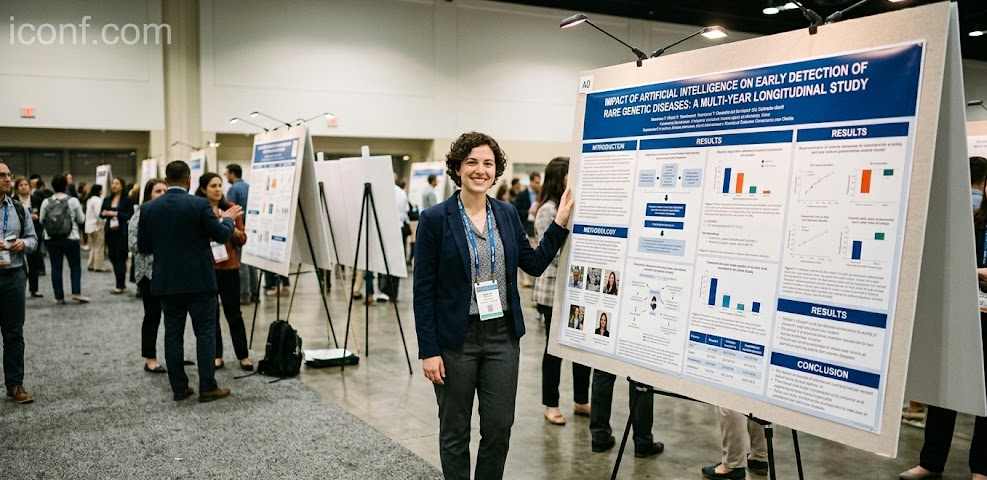
Conference organizers utilize standardized presentation boards. Depending on the region hosting the event, you will generally encounter one of two primary size standards.
The International Standard: A0 Size For most conferences held in Europe, Asia, and the UK, organizers default to the ISO 216 standard paper sizes.
Dimensions: 84.1 cm x 118.9 cm (33.1 x 46.8 inches).
Orientation: Portrait (vertical) is the most common for A0 display boards, though some venues permit Landscape (horizontal).
The North American Standard: 36 x 48 Inches If you are attending a conference in the United States or Canada, standard architectural sizing is utilized instead of the A-series.
Dimensions: 36 x 48 inches (91.4 cm x 121.9 cm).
Orientation: Landscape (horizontal) is the overwhelming standard in North American venues.
How to Check: Always verify the "Guidelines for Presenters" on the specific event website or through academic directories like call4papers.org or iconf.com before opening your design software. The required dimensions and permitted orientations will be explicitly stated.
A successful academic poster is not a copy-pasted journal article; it is a visual summary. The standard 3-column layout is universally accepted and naturally guides the reader's eye from top-left to bottom-right.
Top Banner (Spans all columns):
Title: Keep it under 15 words.
Authors & Affiliations: Include university logos in the top corners.
Column 1: The Setup
Abstract/Introduction: A brief context of the problem.
Objectives: Use bullet points to state your research questions clearly.
Column 2: The Core (Widest or Most Prominent)
Methodology: Keep text minimal. Use flowcharts or diagrams to explain your process.
Results (Data): This should be the focal point of the entire poster. Use large, high-resolution charts, graphs, or heat maps. Ensure axes are clearly labeled.
Column 3: The Takeaway
Discussion/Conclusion: What do the results mean? Use bullet points.
References & Acknowledgments: Keep this section small and strictly limited to highly relevant citations and funding bodies.
Researchers at a poster session are walking past dozens of boards. Your design must be readable from at least 1.5 to 2 meters (5 to 6 feet) away.
Word Count: Aim for 300 to 800 words maximum. Let the graphics do the heavy lifting.
Title Font Size: 80pt to 100pt (Must be readable from across the aisle).
Section Headings: 40pt to 50pt.
Body Text: 24pt to 36pt (Never go below 24pt, or it will be unreadable).
Color Scheme: Use a high-contrast design. A light background (white or light gray) with dark text (black or dark blue) is the safest and most professional choice. Avoid dark backgrounds with white text, as they are difficult to read and expensive to print.
If you are preparing for an upcoming business trip to a conference in Yokohama this late March, particularly if it is your very first time traveling abroad, navigating international airport security with a massive paper roll can be stressful.
The Hard-Shell Tube: Always transport a paper poster in a hard plastic telescopic tube with a carrying strap. Treat it as a carry-on item; never check it into the cargo hold, as it can easily be crushed or lost.
Fabric Posters: A modern alternative is printing your design on wrinkle-resistant fabric. Fabric posters can be folded securely in your suitcase alongside your clothes, completely eliminating the need for a carrying tube.
Local Printing: To avoid travel logistics entirely, locate a commercial print shop near your destination hotel or the conference venue. You can email them the PDF a week in advance and simply pick up the pristine, printed poster upon arrival in the host city.
Would you like me to generate a checklist on how to effectively deliver a 60-second "elevator pitch" to summarize your poster for networking during the session?

