
655 views||Release time: Feb 26, 2026
When you receive an acceptance letter from an academic conference, it will typically specify how you are expected to present your research: as an Oral Presentation or a Poster Session.
For first-time attendees, this can cause some confusion. Is one better than the other? Does a poster mean your research was graded lower?
Here is a definitive guide to the differences between oral and poster presentations, how they function, and how to maximize your success in either format.
| Feature | Oral Presentation | Poster Session |
| Format | Slide deck (PowerPoint/Keynote) at a podium. | Large printed visual poster displayed on a board. |
| Duration | 10 to 20 minutes (strict time limit). | 1 to 2 hours (open networking timeframe). |
| Audience | A seated room of 20 to 200+ people. | Passing foot traffic; 1-on-1 conversations. |
| Engagement | One-to-many. Limited Q&A at the end. | One-to-one. Highly interactive and continuous. |
| Preparation | Rehearsing a timed script and slide transitions. | Designing a highly visual, self-explanatory graphic. |
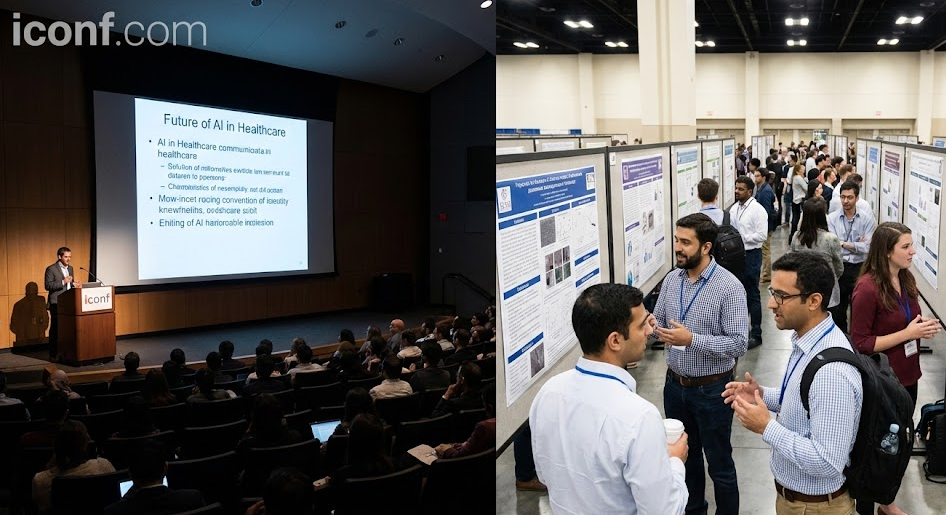
An oral presentation is the traditional format most people imagine when they think of a conference. You stand at a podium, control a slide deck, and speak to a seated audience.
How it Works: You are grouped into a "Session" with 3 or 4 other researchers presenting on similar topics. A Session Chair introduces you, monitors the clock, and manages the microphone.
Pros:
Broad Reach: You can broadcast your findings to a large room of people simultaneously.
Undivided Attention: You have the floor, and the audience is quiet and focused entirely on you.
Efficiency: Once your 15 minutes are up, your presentation duty is complete.
Cons:
High Pressure: Public speaking can be nerve-wracking, especially if presenting in a second language.
Strict Timing: If you run over your allotted time, the Chair will cut you off.
Limited Feedback: You only have a few minutes for questions, meaning you rarely get deep, constructive feedback.
A poster session is an interactive, exhibition-style event.
How it Works:
You are assigned a physical board in a large hall where you pin up a large-format printed poster summarizing your research. During the designated 1-to-2-hour session, all attendees wander the hall. You stand by your poster, give 2-minute "elevator pitches" to people who stop, and answer their questions directly.
Pros:
Deep Networking: You have actual conversations. If a senior researcher stops by, you can talk to them for 15 minutes and exchange contact information.
Low Pressure: It feels like a casual conversation rather than a high-stakes performance.
Detailed Feedback: Because the interaction is one-on-one, peers can point directly to your data and offer highly specific advice or collaboration ideas.
Cons:
Fatiguing: You must stand and talk continuously for hours.
Competing for Attention: You are in a loud room with hundreds of other posters. If your poster is visually boring, people will simply walk past it.
A very common misconception among graduate students is that being assigned a Poster Session means the peer-review committee thought the paper was "weak."
In most fields (especially Computer Science and Engineering), this is false. Whether you present orally or via poster, the actual paper published in the conference proceedings is identical. The indexing (e.g., Scopus, EI Compendex) and the academic credit you receive for graduation are exactly the same.
Committees assign oral slots based on what makes a cohesive 90-minute narrative for an audience. They assign poster slots to highly technical or data-heavy papers that benefit more from visual, up-close examination.
If assigned an Oral Presentation: Focus on storytelling. Do not put walls of text on your slides. Your goal is to make the audience understand the impact of your work, not the minute mathematical details.
If assigned a Poster: Focus on visual hierarchy. Your poster should be readable from 5 feet away. Prepare a snappy, 60-second summary to hook people as they walk by.

