
672 views||Release time: Feb 24, 2026
If your research paper has just been accepted into an academic conference, congratulations! However, your work is not quite finished. The acceptance email will inevitably ask you to submit your "Camera-Ready" paper by a strict deadline.
In the context of academic conferences and journals, a camera-ready paper is the final, polished, and non-negotiable version of your manuscript that is ready for official publication.
When you submit this version, you are telling the conference organizers and publishers that the document is flawless. No further typesetting, editing, or proofreading will be done by the publisher. What you submit is exactly what will appear in the digital library and printed proceedings.
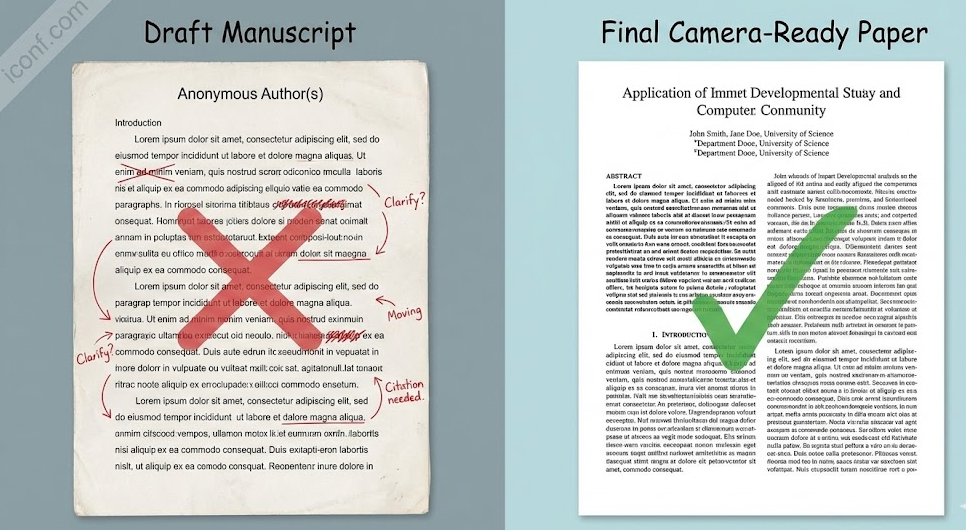
The term is a legacy from the days of traditional offset printing. Before the era of digital publishing and PDFs, authors had to print their final manuscripts on high-quality paper and mail them to the publisher. The publisher would then literally photograph the pages with a high-resolution camera to create the printing plates.
If your paper had a smudge, a typo, or an incorrect margin, the camera would capture it, and that error would be permanently printed in the book. Today, the process is entirely digital, but the term remains to emphasize that the document must be visually and technically perfect.
Many first-time authors assume they can just re-submit their original draft. This is a critical mistake. Here is how the two versions differ:
| Feature | Initial Submission (Draft) | Camera-Ready (Final) |
| Primary Purpose | For Peer Review | For Official Publication |
| Author Details | Often Anonymous (Double-Blind Review) | Must include all Author Names & Affiliations |
| Content Quality | May contain minor typos or formatting errors | Must be 100% error-free |
| Formatting | Focuses on readability for reviewers | Pixel-perfect adherence to publisher templates |
| File Validation | Standard PDF upload | Strict ISO-compliant PDF (e.g., IEEE PDF eXpress) |
| Future Revisions | Allowed and expected after review | Strictly prohibited after submission |
Preparing your final manuscript involves several mandatory steps. Missing any of these can result in your paper being pulled from the conference proceedings.
Your acceptance is almost always conditional on making the changes requested by the peer reviewers. You must revise your paper to address their feedback, correct typos, and ensure all figures are high-resolution and readable.
If the conference utilized a double-blind review process, your original submission had your name and university stripped out. You must now add the author names, email addresses, affiliations, and any funding acknowledgments back into the document.
You must ensure your paper strictly follows the conference's designated template (such as the IEEE 2-column format or the Springer LNCS format). Check the margins, font sizes, line spacing, and citation styles.
For many major publishers like IEEE, you cannot simply use the "Save as PDF" function in Microsoft Word. You must process your source file (Word or LaTeX) through a specialized validation tool like IEEE PDF eXpress. This tool ensures that all fonts are properly embedded and that the file meets digital archiving standards.
Along with the camera-ready PDF, you are required to sign and submit a Copyright Transfer Form. This legally grants the publisher the right to distribute and index your work in databases like Scopus or EI Compendex.
Before you hit the final submit button on platforms like EasyChair, EDAS, or CMT, verify these final details:
Are all author names spelled correctly and in the right order? (These cannot be changed after publication).
Are there any page numbers on the document? (You usually need to remove them, as the publisher will add proceeding-wide page numbers later).
Are all charts and graphs legible when printed in black and white?
Do you have the validated PDF, the source files, and the signed copyright form ready?

