
505 views||Release time: Feb 24, 2026
For Master’s and PhD students, publishing research is often a strict requirement to defend a thesis and graduate. But when you are under a tight deadline, submitting to a conference is much faster than waiting for a journal.
This leads to the ultimate question: Does a conference paper actually count as a valid publication for graduation?
The short answer is: It depends entirely on your field of study, your university's specific policies, and the indexing status of the conference.
Here is the detailed breakdown of how academic institutions evaluate conference papers for graduation credit.
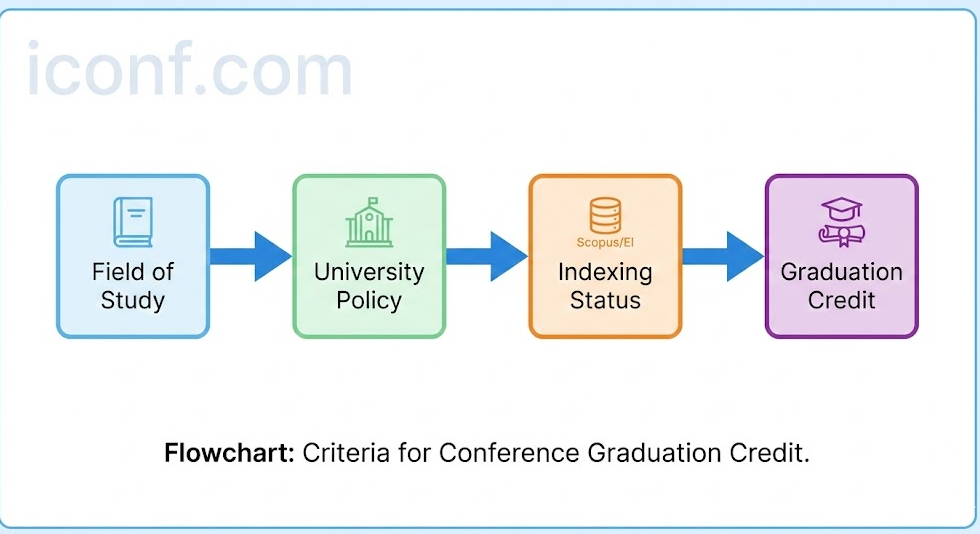
The biggest factor determining whether a conference paper counts is your academic major. Different fields value conferences differently.
Computer Science, AI, and Electrical Engineering: YES In the computing and technology fields, conferences are the primary mode of publishing. Technologies evolve too rapidly for the 12-to-18-month review cycle of traditional journals.
If you publish in a top-tier conference (e.g., CORE A/A* ranked, IEEE, ACM), almost all universities will count this heavily toward your PhD graduation requirements. In many CS departments, conference papers are actually preferred over journal articles.
Mechanical, Civil, and Industrial Engineering: PARTIAL/SOMETIMES In general engineering, conference papers are valued for networking and preliminary findings, but they may only count as "partial" credit.
For example, your department might require "two SCI journal papers OR one SCI journal paper and two EI-indexed conference papers" to graduate.
Natural Sciences (Biology, Chemistry, Physics) and Humanities: NO In the natural sciences and humanities, conferences are viewed strictly as venues for discussion, not final publication.
Conference abstracts or proceedings in these fields almost never count toward graduation. You must publish in peer-reviewed journals (SCI, SSCI, or AHCI) to meet your degree requirements.
Even if your department accepts conference papers, they will not accept just any conference. The paper must be published in a reputable database to prove it underwent rigorous peer review.
Universities typically look for the following indexing standards:
EI Compendex: The gold standard for engineering conferences. If your university requires an "EI paper," an EI-indexed conference proceeding will fulfill this.
Scopus: Widely accepted across Europe and Asia. A Scopus-indexed conference proceeding is often the minimum baseline for Master's students to graduate.
Web of Science (CPCI): The Conference Proceedings Citation Index is highly respected, though SCI/SSCI journals are still prioritized.
Warning: If you publish in an unindexed, predatory, or "pay-to-publish" conference, the graduation committee will reject the publication, and you will not receive credit.
Graduation rules vary drastically by geography and institution.
Asia (China, India, Southeast Asia): Universities here often have rigid, quantitative requirements. A graduation handbook might explicitly state: "A PhD candidate must publish at least one SCI-indexed journal and one EI-indexed conference proceeding." In this case, the rules are black and white.
North America and Europe (UK, US, Germany): Universities often have qualitative, flexible requirements. Rather than a strict quota, your PhD supervisory committee decides when your body of work is "sufficient." A few high-impact conference papers may easily convince them you are ready to defend.
Do not guess when it comes to your degree. Take these three steps immediately:
Read the Graduate Student Handbook: Every department publishes a formal document outlining exact publication quotas. Look for terms like "acceptable venues," "indexed proceedings," or "equivalent credits."
Consult Your Supervisor: Your Principal Investigator (PI) has guided students through this process before. Ask them specifically: "Will an IEEE conference paper fulfill my publication quota, or do I need an IEEE Transactions journal?"
Check Alumni Records: Look at the CVs or thesis defense announcements of students who graduated from your lab last year. Where did they publish?
If you are a Computer Science or Engineering student targeting an IEEE, ACM, or Springer conference that is EI/Scopus indexed, it is highly likely to count toward your graduation. If you are in the Sciences or Humanities, you should focus your energy on traditional journal submissions instead.

