
700 views||Release time: Jan 13, 2026
At the heart of academic publishing lies the Peer Review Process—the system where experts evaluate your work before it enters the scientific record.1 However, not all reviews are created equal.
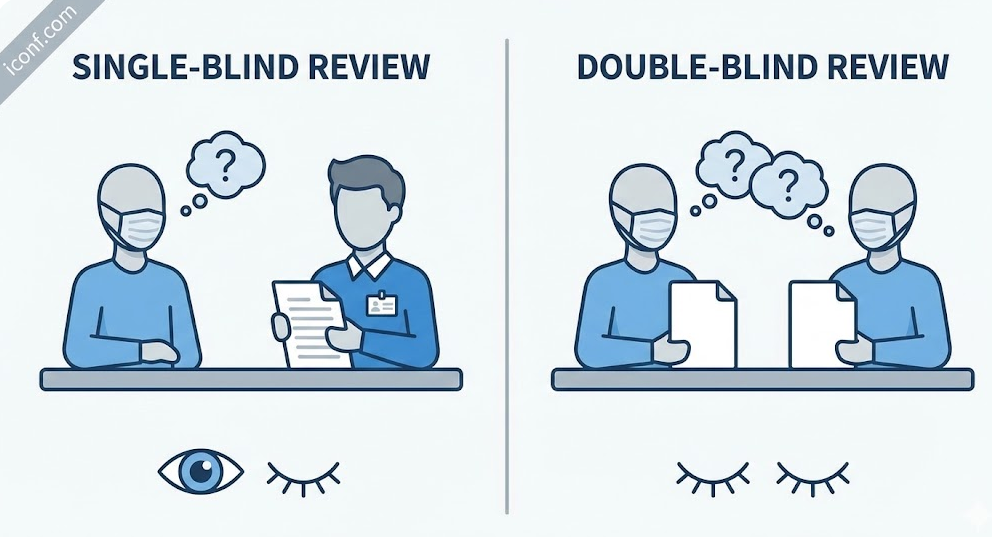
The two dominant models, Single-blind and Double-blind, operate on different philosophies regarding anonymity and bias. Understanding these differences is crucial when choosing a target journal for your research in 2026.
1. Single-blind Review (The Traditional Standard)
This is the most common model in Science, Technology, and Medicine (STM).
Pros & Cons
|
Pros |
Cons |
|
Honesty: Reviewers feel safe to be critical. |
Bias: Reviewers may be biased by the author's gender, nationality, or university ranking (e.g., favoring a Harvard paper over a lesser-known university). |
|
Context: Knowing the author helps reviewers assess if the work fits the author's previous research trajectory. |
The "Matthew Effect": Famous authors often get an easier pass ("The rich get richer"). |
2. Double-blind Review (The "Fair" Standard)
This model is standard in Social Sciences, Humanities, and increasingly in Computer Science (e.g., CVPR, ACL).
Pros & Cons
|
Pros |
Cons |
|
Fairness: It levels the playing field. A PhD student has the same chance as a Nobel Laureate. |
Anonymization Burden: Authors must strip all names, acknowledgments, and self-citations from the text. |
|
Focus on Content: Removes "Prestige Bias." |
Hard to Enforce: In niche fields, reviewers can often guess the author based on the writing style or specific references. |
3. Emerging Trends in 2026: Open & Triple-Blind
As academia strives for transparency, two new models are gaining traction:
Summary: Which is Better?

